
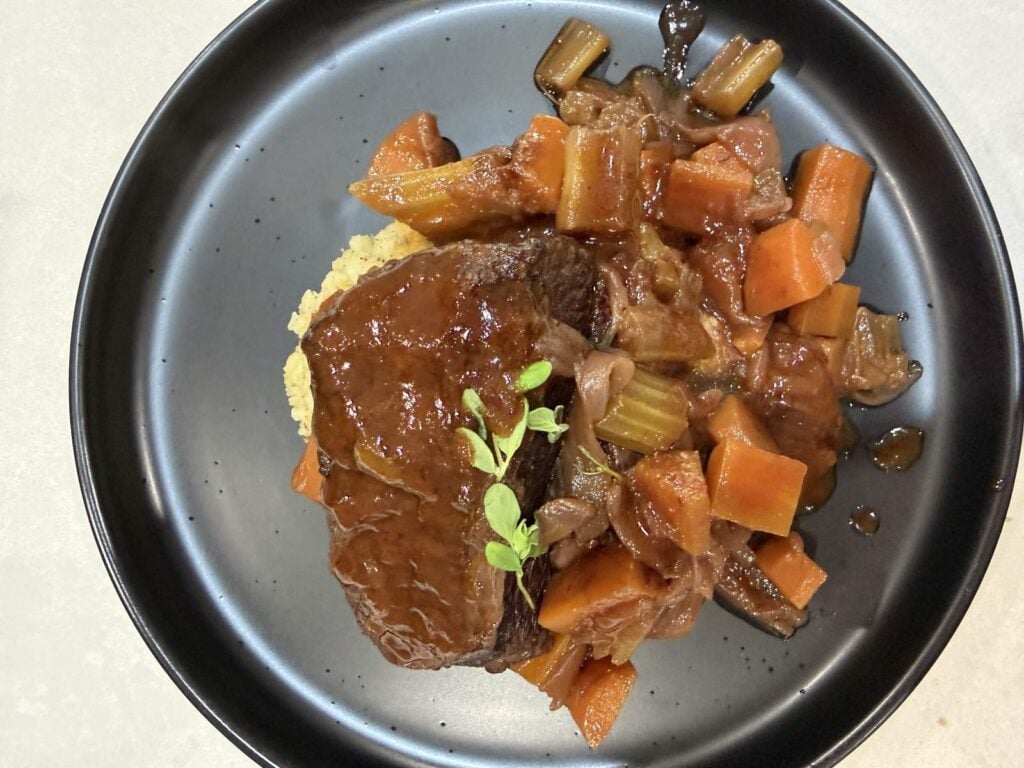
Picture it. The light fading over the Fleurieu, a bottle of Shiraz already open, and two short ribs sinking into a slow red wine braise that has been quietly working its magic for five hours. The house fills with the scent of thyme and reduced wine, the kind of smell that makes you want to pull someone close and pour them a glass. This is John’s dish, the one he gives a whole afternoon to, and when it finally comes to the table the meat falls from the bone at the touch of a fork, draped in a glossy dark jus, resting on a pillow of mash threaded with roasted wattleseed and warm native pepperberry. A dish made for lingering over, for candlelight and second helpings and no rush to be anywhere. Slow food, the way it should be.
Why this dish works
Short ribs are built for the long, slow treatment. All that connective tissue and marbling needs hours of gentle heat to melt down into silk, and there is no shortcutting it. Five hours at a bare simmer is what turns a tough, cheap cut into something that falls apart under a fork. Reducing the wine right at the start, while your hands are busy with the searing and the soffritto, means it goes into the pot already glossy and concentrated, so the sauce is deep and rounded from the very first minute.
Start with great beef
A braise this simple lives or dies on the quality of the meat, so this is the place to spend. We use quality beef short ribs, raised on the open pastures of Southern Australia. They are beautifully marbled and the meat falls effortlessly from the bone after a long braise, which is exactly what you want here.
The native twist
The mash is where the Fleurieu and South Australian story comes through. Roasted wattleseed brings a warm, roasted note somewhere between coffee and hazelnut, while native pepperberry, also called mountain pepper, gives a slow heat that builds gently at the back of the palate. Both sing against red wine and beef. Go gently with the pepperberry the first time, it is more potent than black pepper and the heat is delayed, so add half, taste, then build.
The recipe
John’s Beef Short Ribs in Red Wine on Wattleseed and Pepperberry Mash

Equipment
- Heavy based pot or Dutch oven with lid
- Separate saucepan for reducing the wine
- Potato ricer or masher
Ingredients
For the ribs
- 2 beef short ribs about 350g each, bone in, ideally Thomas Farms beef short ribs
- 1 tbsp olive oil
- Sea salt and freshly cracked black pepper
- 5 shallots diced
- 2 large carrots diced
- 1 large stick celery diced
- 2 tbsp tomato paste
- 750 ml red wine Fleurieu or McLaren Vale Shiraz
- 500 ml beef stock
- 3 sprigs thyme
For the wattleseed and pepperberry mash
- 600 g floury potatoes Sebago or Dutch Cream, peeled and chunked
- 80 g butter
- 1 tsp ground roasted wattleseed
- 1/2 tsp ground native pepperberry (mountain pepper) or to taste
- Sea salt
Instructions
The ribs
- Take the ribs out of the fridge 30 minutes ahead. Pat them very dry, then season firmly all over with salt and pepper. Dry meat is what gives you that deep crust, so do not skip this.
- Pour the wine into a separate saucepan, bring it to a steady boil, then leave it ticking away to reduce while you get on with the ribs and vegetables. You want it halved, glossy and slightly syrupy, which takes around 8 to 10 minutes. Keep half an eye on it and pull it off the heat once it is there. Reducing the wine before it goes in concentrates the flavour and burns off the sharp alcohol, so the sauce is rounded and deep from the start.
- Heat the olive oil in a heavy pot over medium-high. Sear the ribs on every side until darkly browned, 3 to 4 minutes a side. Take your time, that colour is pure flavour. Set the ribs aside.
- Drop to medium heat. In the same pot, soften the diced shallots, carrot and celery for 7 to 8 minutes until they catch a little colour.
- Stir in the tomato paste and cook it out for 2 minutes until it darkens, which takes away the raw tinned edge and builds a richer base.
- Pour the reduced wine into the vegetables, scraping the bottom of the pot to lift all the browned bits. Return the ribs, then add the 500ml of beef stock. Tuck in the thyme.
- Bring to a bare, gentle simmer. Cover with the lid on and hold it at the laziest simmer your gas hob will give you for 5 hours, turning the ribs once or twice. You are looking for the occasional lazy bubble, never a rolling boil. The meat is ready when it surrenders off the bone at the touch of a fork.
- Lift the ribs out and rest them. Skim only the excess fat from the surface, then simmer the sauce uncovered for 15 to 20 minutes to reduce and intensify it into a proper jus, glossy and deeply concentrated, thick enough to coat the back of a spoon. Taste and adjust the salt. Do not waste a drop of this, it is the whole soul of the dish.
The mash
- While the sauce reduces, boil the potatoes in well-salted water until completely tender, about 18 to 20 minutes. Drain and let them steam dry in the colander for a couple of minutes. Dry potatoes drink up butter far better than wet ones.
- Pass them through a ricer or mash thoroughly, then beat in the butter, wattleseed and pepperberry. Season with salt to taste. Go gently with the pepperberry at first, it builds, so taste as you add.
To serve
- Spoon a generous bed of the wattleseed and pepperberry mash onto each plate. Sit a short rib on top, pile the braised vegetables around, and spoon the glossy red wine jus over and around.
Notes
Do not waste a drop
That jus is five hours of work in liquid form, so treat it like gold. Any you have left over becomes the savoury base for a beef noodle dish the next night, or a soup, a pie, or a sauce stirred through fresh pasta. If you love this kind of slow, generous, native-led cooking, it is exactly the sort of thing we do together in our classes across the Fleurieu Peninsula. Come and cook with us.