
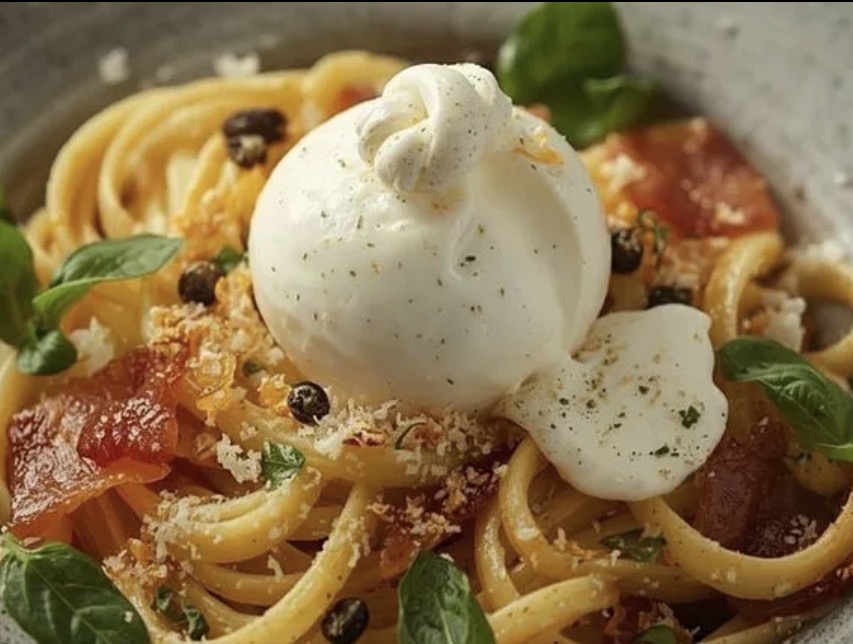
There’s something deeply satisfying about the moment brown butter hits its sweet spot – that nutty, toasted aroma that fills the kitchen and makes everyone stop what they’re doing to breathe it in. This dish takes that moment and layers it with the unmistakable fragrance of lemon myrtle, one of Australia’s most extraordinary native ingredients. Paired with crispy fried prosciutto, fried capers, and a whole burrata sitting proudly on top waiting to be broken into, this is autumn comfort food with a Fleurieu twist. It’s the kind of dish that feels like a restaurant plate but comes together in under 30 minutes, and it never fails to get a reaction in our classes.
Brown Butter Lemon Myrtle Tagliatelle with Burrata

There's something deeply satisfying about the moment brown butter hits its sweet spot – that nutty, toasted aroma that fills the kitchen and makes everyone stop what they're doing to breathe it in. This dish takes that moment and layers it with the unmistakable fragrance of lemon myrtle, one of Australia's most extraordinary native ingredients. Paired with crispy fried prosciutto, fried capers, and a whole burrata sitting proudly on top waiting to be broken into, this is autumn comfort food with a Fleurieu twist.
Ingredients
- 100 g unsalted butter cut into cubes
- 1/2 teaspoon dried lemon myrtle leaf finely ground (see Chef’s Tips)
- 1 large lemon zested and juiced (about 2 tablespoons juice)
- 2 cloves garlic crushed
- Fine sea salt to taste
- Freshly cracked black pepper
- Fresh pasta sheets for herb-embedded pasta
- 1/2 teaspoon dried lemon myrtle leaf finely ground, for pressing between pasta layers
- 1 lemon rind finely grated, for pressing between pasta layers
- Fresh basil leaves for pressing between pasta layers
- A dash of fine sea salt
- 6 slices prosciutto
- 2 tablespoons small capers drained and patted very dry
- Fresh basil leaves a generous handful
- 2 whole burrata balls approximately 150g each, at room temperature
- Extra virgin olive oil for drizzling
- Flaky sea salt such as Murray River salt flakes
Instructions
- Remove the burrata from the fridge at least 30 minutes before serving. Cold burrata is firm and tight – at room temperature, the creamy stracciatella centre will flow beautifully when your diners break into it. Set it on a plate lined with paper towel to catch any excess liquid.
- Heat a large, dry frying pan over medium-high heat. Lay the prosciutto slices flat in the pan (work in batches if needed, don’t overlap). Cook for 1-2 minutes per side until deeply golden and crisp. The slices will curl and shrink as they cook. Transfer to a plate lined with paper towel. Once cool enough to handle, crumble or break into rough shards. Set aside. Keep the rendered prosciutto fat in the pan – you’ll use it to fry the capers next.
- With the prosciutto fat still in the pan over medium-high heat, wait until it shimmers. A good test is to drop one caper in – it should sizzle immediately and vigorously. Add the remaining capers carefully (they will splutter, so stand back). Fry for 60-90 seconds until they open up like tiny flowers and turn crispy. Remove with a slotted spoon to paper towel. These will crisp further as they cool. Wipe the pan clean but don’t wash it – you want those savoury flavour traces for the brown butter.
- Prepare the herb-embedded pasta. Lay out your fresh pasta sheets on a lightly floured surface. Scatter the ground lemon myrtle, finely grated lemon rind, and fresh basil leaves evenly across one sheet. Place a second pasta sheet on top and press firmly to seal the herbs between the layers. Cut into tagliatelle strips. Bring a large pot of water to a rolling boil with a dash of salt and the crushed garlic. Cook the fresh pasta for 2-3 minutes until al dente – fresh pasta cooks much faster than dried. Before draining, scoop out a full cup (250ml) of the starchy pasta water. This is your secret weapon for bringing the sauce together later.
- While the pasta cooks, place the butter cubes in the same frying pan. Set it over medium heat. The butter will melt, then foam, then begin to spit as the water cooks out. Swirl the pan gently and watch closely. After about 3-4 minutes, the foam will subside and you’ll see golden-brown flecks forming at the bottom of the pan. The butter will smell intensely nutty and toasted. This is the moment. Immediately pull the pan off the heat.
- With the pan off the heat, add the crushed garlic. Stir for 30 seconds – the residual heat will soften the garlic without burning it. Add the lemon zest and squeeze in the lemon juice.
- Return the pan to medium-low heat. Add the drained tagliatelle and about half the reserved pasta water (125ml). Toss everything together vigorously using tongs, lifting and turning the pasta so every strand is coated. The starch in the pasta water will emulsify with the butter to create a glossy, silky sauce that clings to the tagliatelle. If the sauce looks too thick or the pasta is clumping, add more pasta water a splash at a time. Season with salt and pepper to taste.
- Divide the dressed tagliatelle between two wide, shallow bowls (or four smaller servings). Use tongs to twirl the pasta into a neat mound in the centre of each bowl. Place a whole burrata directly on top of the pasta mound – this is your centrepiece. Scatter the crispy prosciutto shards and fried capers generously over and around the burrata. Tear fresh basil leaves and scatter them across the top. Finish with a drizzle of extra virgin olive oil and a pinch of flaky sea salt over the burrata.
- Bring the bowls to the table and let your diners break into the burrata themselves. When they cut or tear it open, the creamy stracciatella will spill out over the hot pasta and become part of the sauce. This is the hero moment, and it’s half the joy of the dish.
Notes
Chef’s Tips:
- Why lemon myrtle, and how much? Lemon myrtle (Backhousia citriodora) contains roughly 20 times the citral content of regular lemon zest, which is why we use just half a teaspoon here. It’s not replacing the lemon – it’s amplifying and adding a distinctly Australian dimension to the citrus note. You can find dried lemon myrtle leaf from Australian native food suppliers, specialty spice shops, or online. Grind it to a fine powder using a mortar and pestle or spice grinder for even distribution.
- Why brown butter and not just melted butter? When you brown butter, you’re cooking out the water content and toasting the milk solids. Those toasted milk solids create hundreds of new flavour compounds through the Maillard reaction, giving you that deep, nutty, almost caramel-like flavour. The key is watching carefully: there’s about a 30-second window between perfectly browned and burnt. Use your nose as much as your eyes – it should smell like toasting hazelnuts.
- Why dry the capers thoroughly? Water and hot oil don’t mix. Any moisture on the capers will cause violent splattering when they hit the oil. Pat them bone dry with paper towel, pressing firmly. When properly fried, capers crisp up and open like tiny flowers and develop an addictive salty crunch.
- Why reserve pasta water? Pasta water is full of starch from the cooking process. When you toss it with butter and heat, the starch acts as an emulsifier, binding the water and fat together into a smooth, glossy sauce rather than a greasy puddle. Always reserve more than you think you’ll need.
- Burrata temperature matters. Cold burrata straight from the fridge has a firm, almost rubbery texture and the stracciatella centre won’t flow properly. At room temperature (give it a good 30 minutes out of the fridge), the outer shell becomes delicate and the centre becomes gloriously creamy.
- Getting the best from tagliatelle. Tagliatelle’s flat, wide ribbons are ideal here because they create surface area for the brown butter sauce to cling to. Fresh tagliatelle works beautifully too – just reduce the cooking time to 2-3 minutes.
- Gluten-free: Substitute with a good quality gluten-free fettuccine or tagliatelle. Rice and corn blends tend to hold up best. The sauce, garnishes, and burrata are all naturally gluten-free.
- Vegetarian: Omit the prosciutto. To replace the salty, savoury crunch, try frying thin slices of halloumi until golden and crispy, or use toasted breadcrumbs seasoned with salt and a little nutritional yeast. Fried sage leaves also work beautifully alongside the brown butter.
Tried this recipe?Let us know how it was!